⚡ Key takeaways
- Two kinds of HRV chart exist. Lab charts come from a 5-minute ECG while lying still; watch and ring numbers are measured during sleep and usually run higher. Compare your number only with the matching kind.
- In a large lab study, the median RMSSD falls from about 37 ms at 25–34 to about 18 ms at 55–64, and then levels off (solid).
- Men and women differ little on RMSSD, the number most wearables show (solid).
- Healthy people of the same age differ widely. Your own trend tells you more than any chart.
You check your watch, see an HRV of 40 ms, and google “normal HRV by age”. One chart says 20 ms is normal at your age, another says 60. Both can be right, because they measured different things. Below you find the lab range for your age and sex, what is known about watch numbers, and which of the two fits your own reading.
Normal HRV by age and sex: the lab table
If your number came from an ECG at rest, Table 1 is your chart. HRV, heart rate variability, is the small variation in time between heartbeats. Wearables and most studies report it as RMSSD, a measure of beat-to-beat change that mainly reflects your “rest and digest” nervous system.
The values come from Voss and colleagues (PLOS ONE, 2015). They recorded 5-minute ECGs lying down, after 5 to 10 minutes of rest, in 1,906 healthy German adults aged 25 to 74. People with high blood pressure, heart disease, diabetes or medication that affects heart rate were excluded. Table 1 shows the median and, in brackets, the middle half of people.
| Age | RMSSD women | RMSSD men |
|---|---|---|
| 25–34 | 38 ms (26–55) | 36 ms (26–49) |
| 35–44 | 31 ms (22–46) | 29 ms (21–39) |
| 45–54 | 24 ms (17–31) | 22 ms (16–30) |
| 55–64 | 19 ms (13–27) | 18 ms (13–25) |
| 65–74 | 17 ms (11–24) | 17 ms (12–23) |
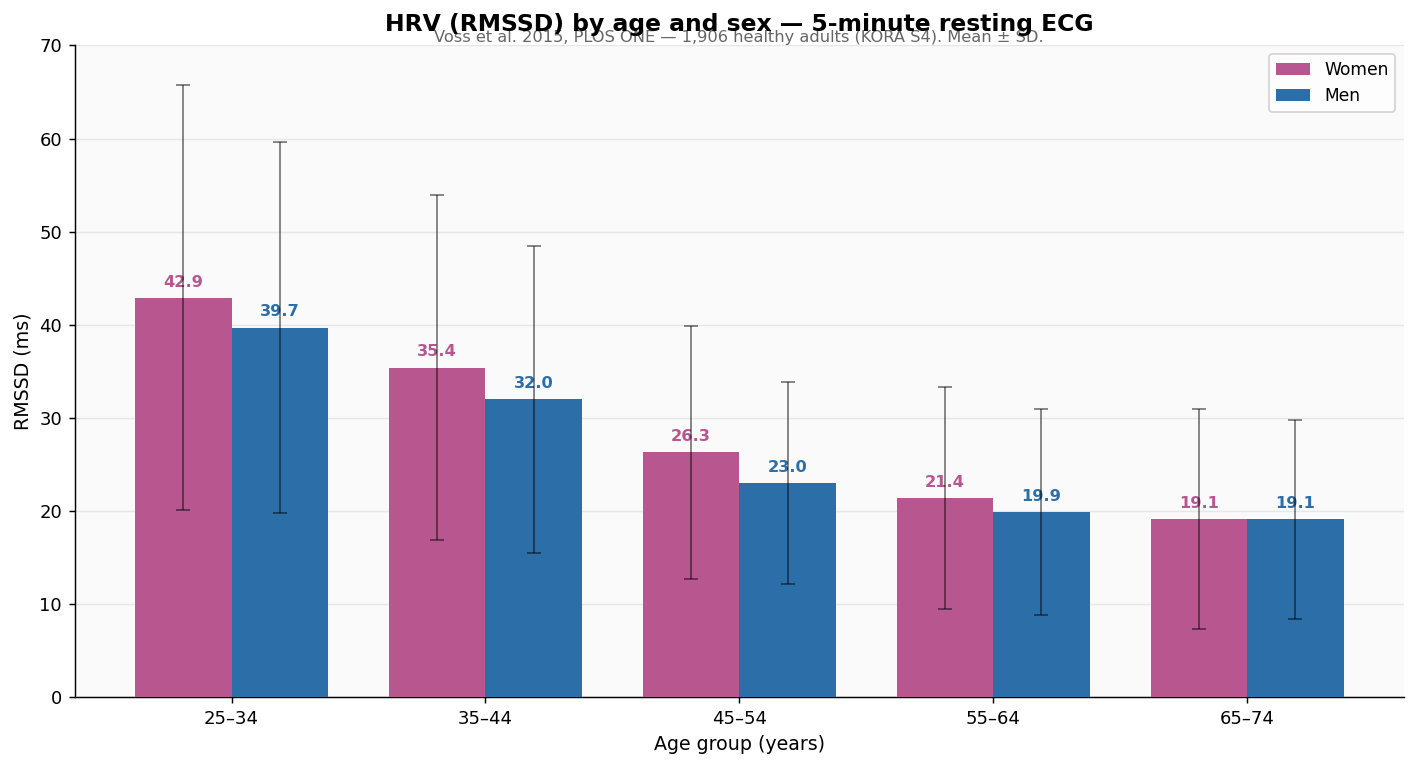
Look at the brackets before you compare yourself. The middle half of healthy 45- to 54-year-olds runs from about 16 to 31 ms. That is why one “good HRV for your age” number doesn’t exist. A 2025 review of 58 studies reached the same conclusion: there are no generally accepted HRV normal values yet, only large studies you can use for orientation.
Normal HRV by age on a watch or ring
Wearable numbers usually run higher than the lab table, and there is no peer-reviewed wearable table by age that you can simply look up. The large Fitbit study by Natarajan and colleagues (Lancet Digital Health, 2020), with 8 million users, found that HRV falls with age and that RMSSD shows no real difference between men and women.
WHOOP publishes ranges from its own members, measured during sleep. This is company data, not peer-reviewed, and only for some ages. The middle half of 45-year-old men fall roughly between 35 and 60 ms, and of 45-year-old women between 30 and 55 ms. Brands also calculate HRV differently, so treat this as a rough guide for a Polar, Garmin or Oura number.
From my own use: I’m in my fifties and wear a Polar Ignite 3. Its overnight HRV sits around 37 to 42 ms, a bit lower in stressful weeks. The lab table says about 18 to 22 ms for a man my age. That doesn’t mean my heart is twice as good as average. It is a different measurement.
Why your number won’t match a chart
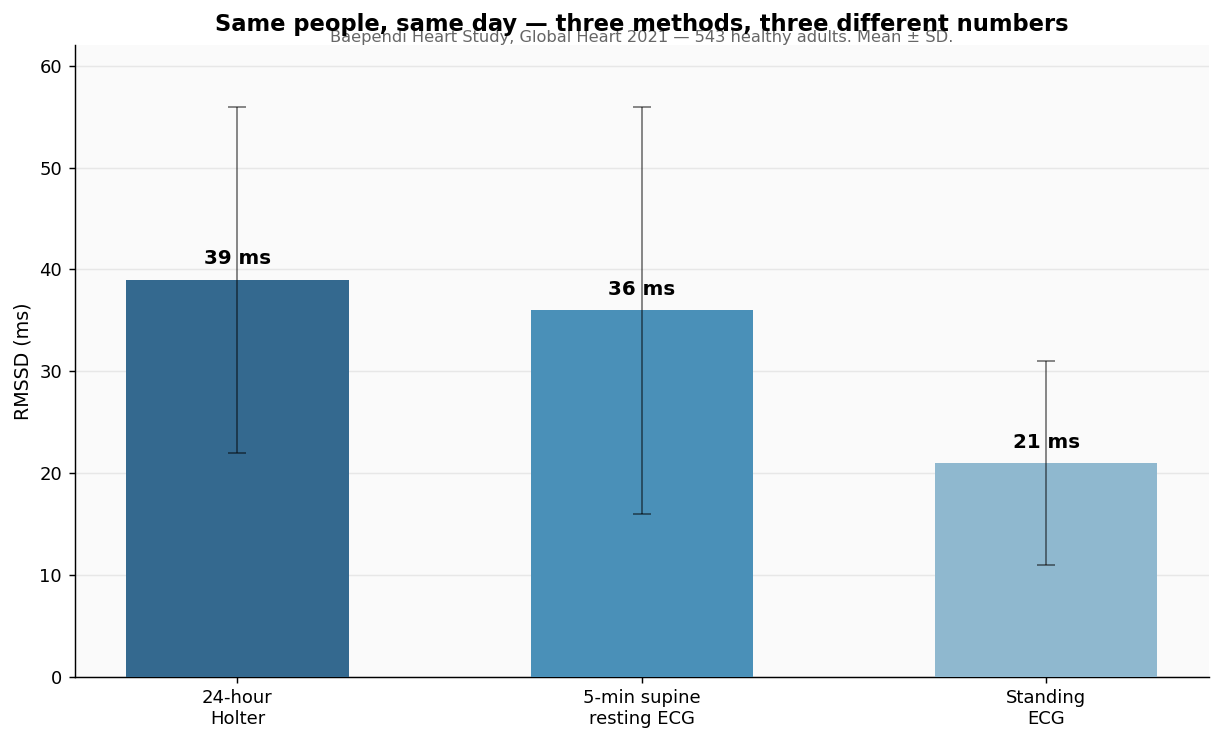
Method and timing change the number more than you’d think. The Baependi Heart Study in Brazil measured the same group of healthy adults three ways. Average RMSSD was 39 ms over 24 hours, 36 ms lying down and 21 ms standing. Time of day matters too: in the Fitbit data, RMSSD peaked between about 5 and 8 am.
Devices also differ from an ECG. In a 2025 test of five wearables over 536 nights, Oura came closest and an older Polar model agreed least well. But the same device makes the same error night after night, so your own trend stays valid. Polar, for example, compares each night with your usual level over the past 28 days.
Why HRV falls with age, and why it levels off
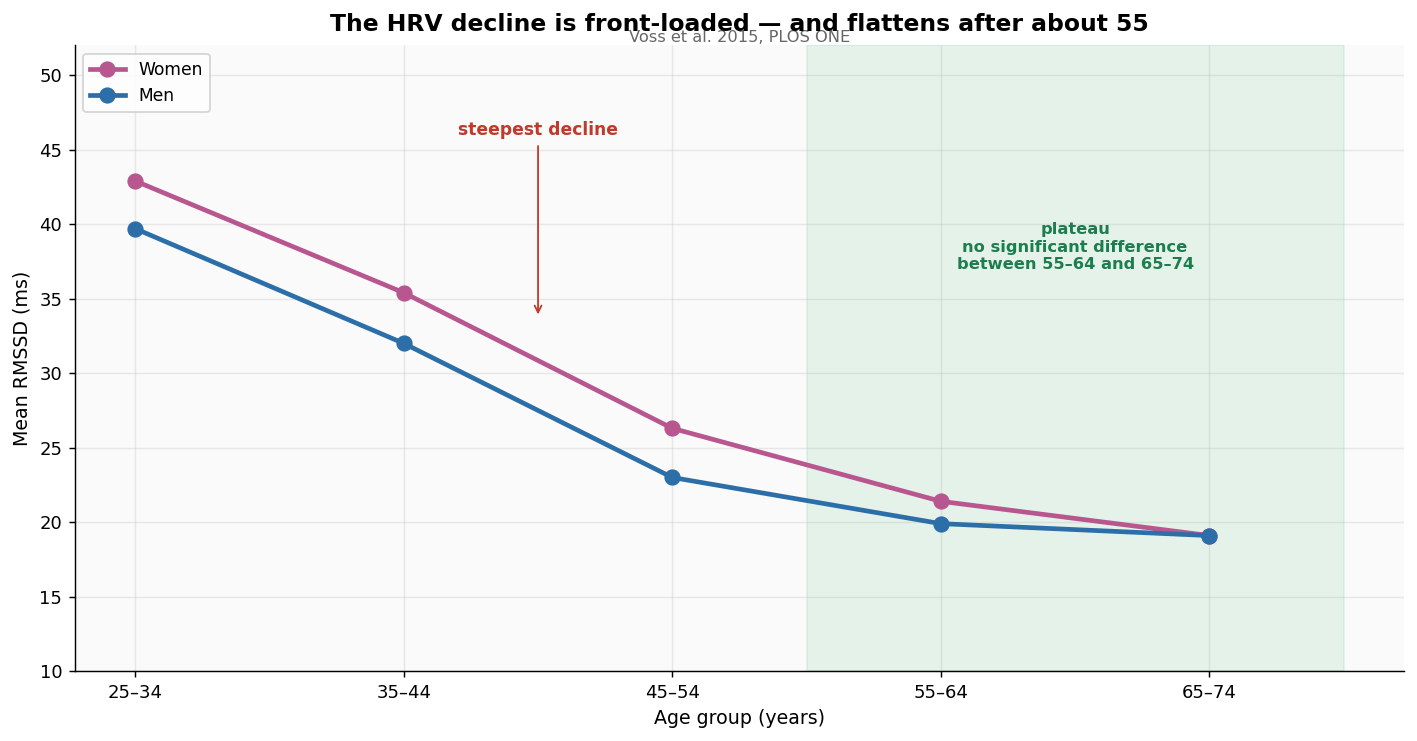
HRV drops fastest between your late thirties and mid fifties, then flattens. In the Voss data, the biggest step was from the 35–44 to the 45–54 group, and the difference between 55–64 and 65–74 was not statistically significant. A 24-hour study of 260 healthy people aged 10 to 99 found the same shape: RMSSD fell to about 47% of its teenage level by the sixth decade and then stabilized.
If you’re in your fifties, the steep part is mostly behind you. What moves your number now is largely sleep, stress, training and illness.
When is a low HRV a reason to worry?
One low night is noise; a drop that lasts for weeks is worth a look. Stress, short sleep, alcohol, travel and a coming cold all push HRV down for a few days. If your number stays below your own usual range for weeks without such a reason, or comes with symptoms such as chest pain, breathlessness or palpitations, see a doctor.
At population level, low HRV goes with higher risk: a meta-analysis of 21,988 people without known heart disease found 32 to 45% more first cardiovascular events in the lowest HRV group. But a 2023 UK Biobank study found that HRV predicted by genes was not linked to mortality. HRV is a mirror of your health, not a lever, and a single reading is never a diagnosis.
What raises HRV
Two habits have solid evidence. Exercise training in previously inactive adults gave a small but real rise in RMSSD, and slow breathing raised vagal HRV during and after practice in a review of 223 studies. What moved my own number from 32 to around 40 ms is in how to improve HRV: what worked for me.
Frequently asked questions
What is a good HRV for my age?
On a 5-minute resting ECG, the median RMSSD is about 37 ms at 25–34, about 23 ms at 45–54 and about 18 ms at 55–64, with a wide healthy range around each. On a watch at night, expect higher numbers. Your own baseline matters more than either.
Is HRV different for men and women?
Barely, for RMSSD: in the lab table the gap is one or two milliseconds, and the Fitbit study found no difference. One 24-hour study found lower HRV in women under 30, a gap that disappeared after 50.
Can I raise my HRV after 50?
Yes. The age-related drop mostly happens before your fifties, and exercise and slow breathing have evidence behind them.
References
- Voss A, et al. Short-term heart rate variability: influence of gender and age in healthy subjects. PLOS ONE 2015;10(3):e0118308, with S1 Complementary Statistics. PMID 25822720
- Brozat M, Böckelmann I, Sammito S. Systematic review on HRV reference values. J Cardiovasc Dev Dis 2025;12(6):214. PMID 40558649
- Natarajan A, et al. Heart rate variability with photoplethysmography in 8 million individuals: a cross-sectional study. Lancet Digit Health 2020;2(12):e650–e657. PMID 33328029
- Geovanini GR, et al. Age and sex differences in heart rate variability and vagal specific patterns: Baependi Heart Study. Global Heart 2020;15(1):71. PMC7583712
- Dial MB, et al. Validation of nocturnal resting heart rate and heart rate variability in consumer wearables. Physiol Rep 2025;13(16):e70527. PMID 40834291
- Umetani K, et al. Twenty-four hour time domain heart rate variability and heart rate: relations to age and gender over nine decades. J Am Coll Cardiol 1998;31(3):593–601. PMID 9502641
- Hillebrand S, et al. Heart rate variability and first cardiovascular event in populations without known cardiovascular disease. Europace 2013;15(5):742–749. PMID 23370966
- Tegegne BS, et al. Phenotypic but not genetically predicted heart rate variability associated with all-cause mortality. Commun Biol 2023. PMC10558565
- Casanova-Lizón A, et al. Does exercise training improve cardiac-parasympathetic nervous system activity in sedentary people? Int J Environ Res Public Health 2022. PMC9656115
- Laborde S, et al. Effects of voluntary slow breathing on heart rate and heart rate variability. Neurosci Biobehav Rev 2022;138:104711. PMID 35623448
Next in this series: How to improve HRV: what worked for me (with data), where you see which lifestyle changes moved my HRV from 32 to around 40 ms.
This article is part of the Lab of One series.
Disclaimer. This article is published for educational purposes only and does not constitute medical advice, diagnosis, or treatment. I am not a clinician. If you have a heart condition or your HRV stays low for weeks, talk to a qualified healthcare professional before drawing conclusions from your wearable.
Correction, October 18, 2026: An earlier version said the Baependi Heart Study measured the same people three ways on the same day. The resting ECGs were taken in the same study period.

Pablo Vicento
The Tested Weekly
One email a week with the guides we tested, sources linked. No spam.