

For months I’ve tracked my heart rate variability every night on a Polar Ignite 3, with one question in mind: at 55, can you actually improve your HRV — and if so, what really moves it? The answer turned out to be yes, in two ways I didn’t expect. My average climbed by about a quarter. And more importantly, the crashes stopped: the floor under my worst nights came up.
The most convincing proof, oddly, showed up in a place where my HRV should have dropped — at 3,400 metres of altitude. I’ll come back to that, because it turned out to be the clearest lesson of the whole experiment.
This is an honest account, confounders and all. It’s an N=1 experiment, not medical advice.
What HRV actually is
Heart rate variability measures the tiny timing differences between consecutive heartbeats. A relaxed, well-recovered nervous system produces more variation; stress, poor sleep, and overtraining flatten it. My Polar reports it as an overnight RMSSD value in milliseconds, measured during the first hours of sleep.
Two things are worth knowing before you compare yourself to anyone. First, HRV is a recovery and stress marker, not a fitness score. Second, it’s deeply personal — my 40 ms is not your 40 ms. Age, genetics, and measurement method all shift the scale. The only comparison that means anything is against your own baseline over time.
If you want the groundwork first — what actually counts as normal for your age, and why your watch’s number won’t match the published charts — I’ve covered that separately in HRV by age: normal ranges from peer-reviewed research. This article is about what happened when I tried to move my own.
Where I started: not low, but unstable
When I began, my HRV averaged around 32 ms. That’s not alarmingly low for my age, but the number bounced everywhere. A single hard session could send me from 39 down to 26 overnight. Good nights touched the high 40s; bad nights fell into the low 20s. The instability was the real problem.
Looking back, part of that came from conditions I hadn’t fixed yet — including a worn-out mattress that was quietly capping my recovery every single night. But the mattress was one symptom of a bigger issue: I wasn’t treating recovery as something I actively managed. That’s what changed.
What I changed — and what you can try
I didn’t chase HRV with tricks or gadgets. I changed how I live, deliberately and on several fronts at once: how I sleep, how I train, how I eat, and how I handle stress. None of it was dramatic. All of it was intentional. Here’s what I did, roughly in order of how much it seems to matter — with an honest note on the evidence for each.
Take sleep seriously — on purpose. I stopped treating sleep as whatever was left over at the end of the day and started protecting it: a more consistent routine, a real wind-down instead of screens until lights out, and a new latex mattress to replace a worn-out one. Now the honest part. When I went back and checked my own sleep data, the measurable numbers barely moved. Duration, sleep score and deep-sleep percentage were all essentially flat across the exact period my HRV climbed. So the gain was not extra hours or more deep sleep — it was more likely the quality of those same hours, the part a wrist sensor cannot see: a better surface, better comfort, fewer small disturbances. Worth knowing before you start chasing sleep-stage percentages.
Train with your heart rate as the brake. The core shift was refusing to keep my heart under pressure for long stretches. I wear a heart rate monitor and let it, not the clock or my ego, set the pace. My interval work is short and controlled: roughly 30 seconds of effort to a target heart rate, then 60 seconds or more of easy recovery, repeated only a handful of times — never grinding it into the ground. The same principle applies to weights: instead of fixed rest periods, I wait until my heart rate has actually come back down before the next set. And on a bigger scale, I check my HRV before training hard again, rather than hammering a body that hasn’t recovered. An early crash from overdoing intervals taught me that lesson the hard way. Training hard is not the same as training well.
Clean up what you eat. Nothing exotic — mostly whole food, enough protein, and cutting out things I’d concluded weren’t doing me any favours, like ultra-processed food. I can’t isolate a nutrition effect in my HRV data and I won’t pretend otherwise. But food is the raw material recovery is built from, and it belongs in the picture.
Treat stress as a lever, not background noise. Work stress is my single biggest HRV suppressor — an anxious day can cut my reading roughly in half and push my resting heart rate up noticeably. I can’t delete it, but I made a deliberate effort to defuse it where I could. My holiday data later showed exactly how much this matters, and it turned out to be the most striking finding in the whole dataset.
Magnesium — small effects at best, most likely via sleep. I take magnesium bisglycinate in the evening. Here is the fair reading of the research: oral supplementation trials do point in a positive direction, but the effects are small, and the best-designed study is weaker than the headlines suggest. A 2026 double-blind, placebo-controlled trial reported a significant group difference in RMSSD — yet neither group actually changed significantly on its own, and the magnesium group moved by 1.45 ms. That is smaller than the measurement error of most wrist wearables. It also used a different form and a lower dose than mine, and found no improvement in sleep at all. The stronger case for magnesium is correcting an actual deficiency, and the plausible route to HRV runs through sleep rather than directly. I treat it as a sleep supporter, not an HRV pill.
Omega-3 — lowers heart rate, weaker on RMSSD. Omega-3 reliably lowers resting heart rate (the effect comes mostly from DHA, not EPA), and it supports parasympathetic balance. But the large pooled analysis found no significant effect on RMSSD — the exact value your watch shows. So I take it for the heart-rate and broader cardiovascular benefits, while being realistic that it may not move the HRV number itself.
GlyNAC (glycine + NAC) — for recovery, not proven for HRV. I take a small dose for glutathione and recovery reasons. In the interest of honesty: the clinical trials on GlyNAC measure oxidative stress, mitochondria, strength, and cognition — not HRV. There’s no trial showing it raises your HRV, and the doses studied were far higher than what most people take. I’m not counting it as an HRV lever, and neither should you.
Notice the shape of that list. The supplements sit at the bottom, with weak or indirect evidence. The things that actually moved my numbers were the unglamorous ones: sleep, training load, and stress.
What the data showed
Here’s the full series, May through August.

The trend is real and statistically significant: HRV rose about 0.74 ms per week (p < 0.0001). Split into phases, the story is clean:
| Phase | Average HRV |
|---|---|
| Old mattress (1–11 May) | 32.9 ms |
| Mattress adaptation (12 May – 30 Jun) | 36.3 ms |
| Post-adaptation (1 Jul – 9 Aug) | 41.2 ms |
Those first eleven days land exactly on my long-term baseline of 32 — and then it climbs steadily.

My all-time record now sits at 59 ms (23 July), with another 54 in early August. But the peak isn’t the story. The floor is. Nights under 30 ms fell from 27% of the time in the first phase to just 6% in the last, and my rolling 14-day floor rose from 28 to 33 ms. One honest caveat, though: my night-to-night swings didn’t get smaller — I still bounce from 37 to 59 and back. The improvement isn’t smaller swings; it’s that the dips stopped going as deep. That’s the accurate way to say it, and it’s still a win.
Two signals, one story
If a rising HRV were just noise, you’d expect nothing else to line up with it. But my night-time heart rate drifted down over the same period — the mirror image of the HRV climb.
The summer nights look messy, and that’s honest: altitude and irregular sleep in Peru threw in spikes and dips. So rather than pretend the raw lines are tidy, I fitted a simple straight trend line through each. That’s the point of a trend line — it looks past the noise to the underlying direction.
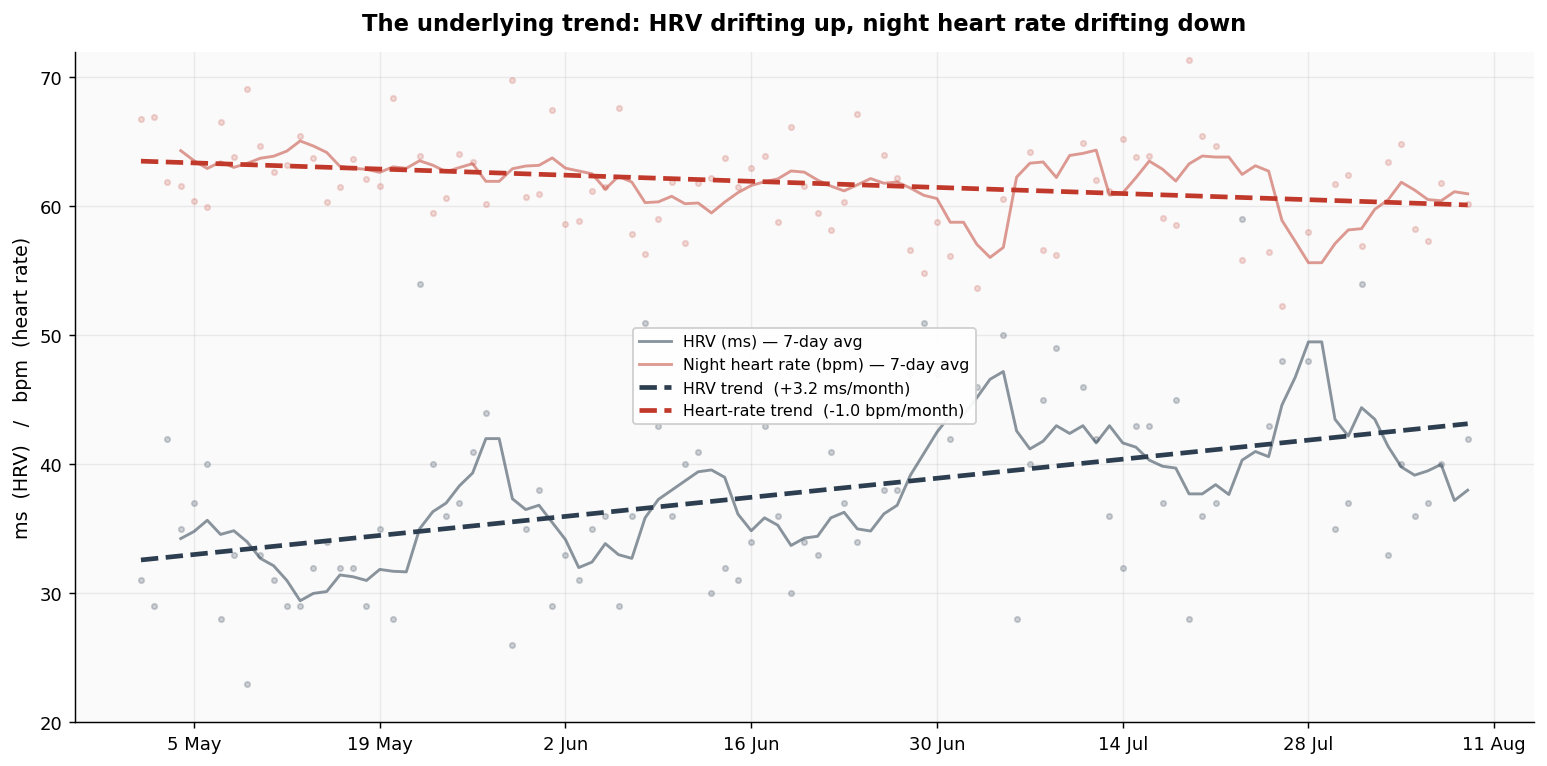
The two trends point in opposite directions — HRV up, heart rate down — and the gap between them narrows over the summer. That’s exactly what better recovery looks like: more parasympathetic activity means both a higher HRV and a lower resting heart rate, and across the whole series the two move together with a correlation of −0.63. Two independent measures telling the same story is far more convincing than one number alone. Honesty note: the HRV trend is rock-solid (p < 0.0001), while the heart-rate trend is weaker and noisier (p = 0.03) — same direction, less certainty.
The altitude paradox
Now that lesson I promised. In July I spent three and a half weeks in Peru at around 3,400 metres. Altitude is supposed to suppress HRV — your body works harder to oxygenate, and parasympathetic activity drops. So I expected my numbers to fall.
They rose.
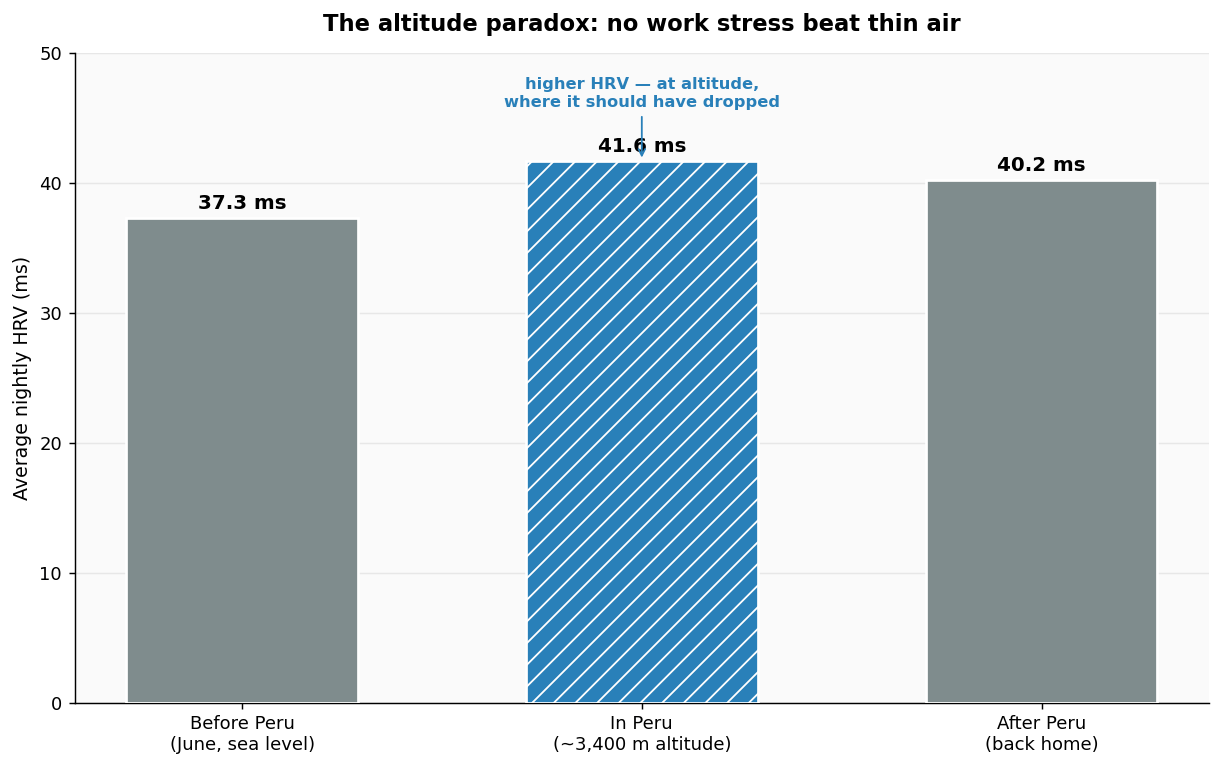
My HRV averaged 41.6 ms in Peru, higher than the 37.3 I’d been running at home at sea level. My deepest recovery night of the entire dataset — 52 bpm, HRV 48 — was my last morning there. My record 59 happened mid-trip.
How? Two things, and I cannot separate them. The obvious one is that the work stress was gone. The less obvious one only showed up when I pulled my step data: in Peru I averaged around 14,500 steps a day against roughly 7,800 at home. Nearly double. So it was not a lazy holiday — it was three weeks of no work pressure combined with a large jump in daily movement, and either or both could be doing the work. Between them they outweighed 3,400 metres of thin air. The altitude was still visible if you look closely — I had a crash to 28 ms with a racing 82 bpm night early on, likely a hard day at elevation — but I acclimatised, and my last four nights there averaged nearly 47 ms.
That’s the whole thesis in one natural experiment: recovery is about how you live — stress, sleep, load — not about your surroundings or your supplement stack.
The honest part: it wasn’t one thing
Here’s where most “how I improved my HRV” articles quietly cheat — they hand you a single hero, usually something you can buy. I can’t do that honestly.
My gains came from changing several things deliberately, over the same stretch of time: prioritising and lengthening sleep, training by heart rate instead of by ego, cleaning up food, and defusing stress where I could. On top of that, a few other variables shifted in the same window — I stopped a high-dose vitamin D protocol and adjusted my magnesium around 12–13 May, days after the new mattress arrived. When that much moves at once, you cannot cleanly credit any single piece. So I won’t hand the trophy to the mattress, or to any one habit. It was a lifestyle change, and the parts I chose on purpose are the ones I’d bet on.
And the July peak? Inflated by the holiday. So the cleanest sea-level, working-life number I have is actually June: 37.3 ms — still a solid step above baseline, without the vacation glow. The reassuring part is that after Peru, back home, I didn’t fall back to 37; I held around 40. If it had been pure holiday effect, it would have evaporated. That it stuck is the best evidence the change is real and durable.
Where I am now, and the takeaway
Laid out honestly: baseline around 32 ms, current sea-level working baseline somewhere in the high 30s to around 40, record 59, and a floor that climbed from 23 to 33. My night heart rate came down a few beats alongside it. The definitive number will settle once I’ve had a few weeks back in a normal work routine — that’s the clean measurement I’m still waiting on.
The real lesson is simple. You probably can improve your HRV, even in your fifties — but the win isn’t a flashy peak, it’s a floor that stops dropping out from under you. And it doesn’t come from one purchase. It comes from protecting your sleep, training with your heart rate as the brake rather than grinding yourself down, eating like it matters, and taking stress seriously as a variable you can influence. Measure the trend, not the record night. Fix your life before you buy pills — a lesson I confirmed, of all places, at 3,400 metres.
What I am changing next
Two adjustments, both unglamorous.
Earlier nights, and a bit more of them. My bedtime still sits around 2 a.m. During my stress-free weeks abroad it drifted closer to 11 p.m. — and that was the best HRV stretch of my year. It will not always work, but the target is simple: consistently before 2 a.m., ideally 1 a.m. or earlier, and a little more total sleep. This is the most obvious lever I have left, and the one I have been least disciplined about.
More training, not harder training. I want to hold or slightly increase my current volume rather than intensity: strength work plus treadmill running for conditioning, and I am planning to add road cycling back into the week as a third element. The rule does not change — heart rate sets the pace, and recovery gets checked before I push again.
Both are testable against the same numbers. If the floor keeps rising, they were worth doing.
Frequently asked questions
What’s a good HRV score?
There’s no universal number. It’s heavily shaped by age, genetics, and how it’s measured — I’ve broken down the published reference values in HRV by age. Track your own trend instead of comparing to strangers online.
How long does it take to improve HRV?
In my experience, meaningful change in the weekly trend shows up over weeks to a couple of months, not days. Single nights are noise — look at a rolling average before you conclude anything.
What affects HRV the most?
For me, the biggest movers were sleep quality, training load — specifically, not overtraining — and stress. My HRV rose at altitude simply because I wasn’t working.
This is a personal N=1 experiment and reflects my own data, not medical advice.

Pablo Vicento
Liked this? There's more where it came from.
Get our digest — articles worth your time, no spam, unsubscribe in one click.
Subscribe to Factnetize →


[…] Vicento · August 13, 2026 […]