⚡ Key takeaways
- Not supported: seed oils cause inflammation. Clinical trials find that linoleic acid, their main fat, does not raise inflammation or oxidative stress.
- Solid: heated seed oils form toxic aldehydes. Frying at high heat breaks them down, and the aldehydes end up in the food.
- Strong link: ultra-processed food. Seed oils are common in packaged food, and that food is tied to cardiovascular death, diabetes and early death.
- Slow: your fat tissue keeps a record. The linoleic acid stored in fat tissue changes with a half-time of almost two years.
Are seed oils bad? Influencers call them poison; mainstream nutrition science calls them heart-healthy. I stopped using them in 2020, switched to real butter and extra virgin olive oil, and started making my own pasta sauces and dressings. The honest answer depends on the claim, so this article takes them one at a time, and ends with what I changed in practice.
What are seed oils?
Seed oils are oils pressed or extracted from plant seeds, as opposed to fruit oils like olive or avocado oil. Common seed oils include soybean, corn, sunflower, canola (rapeseed), cottonseed, safflower, grapeseed and rice bran oil.
In large plants, extraction with the solvent hexane is standard practice, followed by refining. The result is a neutral, shelf-stable oil rich in linoleic acid, an omega-6 polyunsaturated fat. Your body can’t make it, so you need some; the questions are how much, in what food, and what heat does to it.
Claim 1: seed oils cause inflammation
This is the headline claim, and the human evidence does not support it. A 2026 review in Nutrition Today by Penn State nutrition scientist Kristina Petersen and colleagues concluded that clinical trial evidence shows linoleic acid does not promote inflammation or oxidative stress.
The long-term observational data point the same way. A 2025 analysis of 150 publications on cohort studies linked higher omega-6 intake and blood levels to lower rates of cardiovascular disease, cancer and death from any cause. The exceptions were ovarian and endometrial cancer, which were more common. A pooled analysis of 20 cohorts and 39,740 adults found that higher linoleic acid levels went with about a third less type 2 diabetes.
Two caveats: cohort studies show associations, not causes, and that diabetes analysis was partly funded by Unilever, a large food company.
Claim 2: heated seed oils produce toxic compounds
This claim has solid chemistry behind it. When polyunsaturated fats are heated to frying temperature, they oxidize and form aldehydes, reactive compounds such as 4-hydroxynonenal (4-HNE) and acrolein.
University of Minnesota researchers heated soybean oil at 365 °F (185 °C) for five hours and then fried potato pieces in it. The 4-HNE level in the fat inside the potatoes was about the same as in the frying oil: the toxic aldehyde had moved into the food. A 2016 follow-up with soybean, corn and canola oil found that 4-HNE rose with heating time, and that acrolein in French fries mirrored the frying oil.
The type of fat decides how fast this happens. In frying tests at 356 °F (180 °C), oils rich in polyunsaturated fat broke down most, while coconut oil was highly resistant. Chemist Martin Grootveld argues in a 2021 review in Frontiers in Nutrition that these oils should no longer be recommended for high-temperature frying. So for frying, pick a fat low in polyunsaturated fat; this is about the frying pan, not a cold salad dressing.
Claim 3: the omega-6 to omega-3 ratio is out of balance
The shift is real; what it does is less clear. Researcher Artemis Simopoulos estimates that the ratio rose from about 1:1 during human evolution to 20:1 or higher in Western diets today, and she stresses that absolute amounts matter as well as the ratio.
A 2025 University of Bristol study, replicated in the UK Biobank with almost 500,000 people, found that a higher omega-6 to omega-3 ratio went with higher levels of some inflammation markers. Surprisingly, omega-3 itself also raised some markers, and the authors warn against firm conclusions. In practice, the fix covers both readings: less seed oil and more omega-3.
The real problem may be the company seed oils keep
The evidence against that food is far stronger than the evidence against the oil. A 2024 umbrella review in the BMJ, covering almost 10 million people, found convincing evidence linking more ultra-processed food to cardiovascular death, type 2 diabetes and anxiety, and highly suggestive evidence for early death, depression and obesity.
That makes the oil hard to judge on its own. Corn oil from a bag of chips is not the same as corn oil used to roast vegetables. And someone who cuts out seed oils usually cuts out a lot of ultra-processed food too, so any improvement can’t be pinned on the oil alone.
A note on soy and glyphosate
Soybean oil carries baggage the others don’t. In 2025, 96% of US soybean acres were planted with herbicide-tolerant varieties, engineered to survive spraying with weedkillers such as glyphosate.
A study of 31 batches of Iowa soybeans found glyphosate and its breakdown product AMPA in the genetically modified ones, and none in conventional or organic soy. What that means for health is disputed: the WHO’s cancer agency classed glyphosate as probably carcinogenic in 2015, while the European Food Safety Authority found no critical areas of concern in 2023.
My own decision is simple: when almost all of a crop is engineered to be sprayed, I’d rather skip it, because olive oil and butter are easy alternatives.
How long do seed oils stay in your body?
In your fat tissue, a long time: the linoleic acid stored there changes with a half-time of almost two years. The fat you eat becomes part of your cell membranes and your fat stores, which is why fat tissue is used as a marker of what someone ate over the long term.
The classic measurement comes from a trial in the 1960s. Men who switched to a diet high in unsaturated vegetable fat saw the linoleic acid in their fat tissue rise from 11% to 32% over five years, with a half-time of 680 days. At that pace, about three quarters of the change happens in four years, and close to 90% in six.
That trial measured the rise in fat tissue, not the fall, and not blood. Still, it shows why one serving doesn’t poison you for years, and why switching fats is a long-term change rather than a weekend detox. By that math, six years after my switch most of what I stored before should be gone.
What I actually changed
My instinct is simple: the closer food stays to how nature made it, the better. Real butter, olive oil, my own sauces. The research doesn’t prove that butter beats every oil, but it does show the problem with industrial processing and ultra-processed food, and that’s where I’d rather be cautious.
- Cooking fats. I replaced sunflower and canola oil with butter and extra virgin olive oil, because I cook at high heat and the aldehyde evidence is the part I trust.
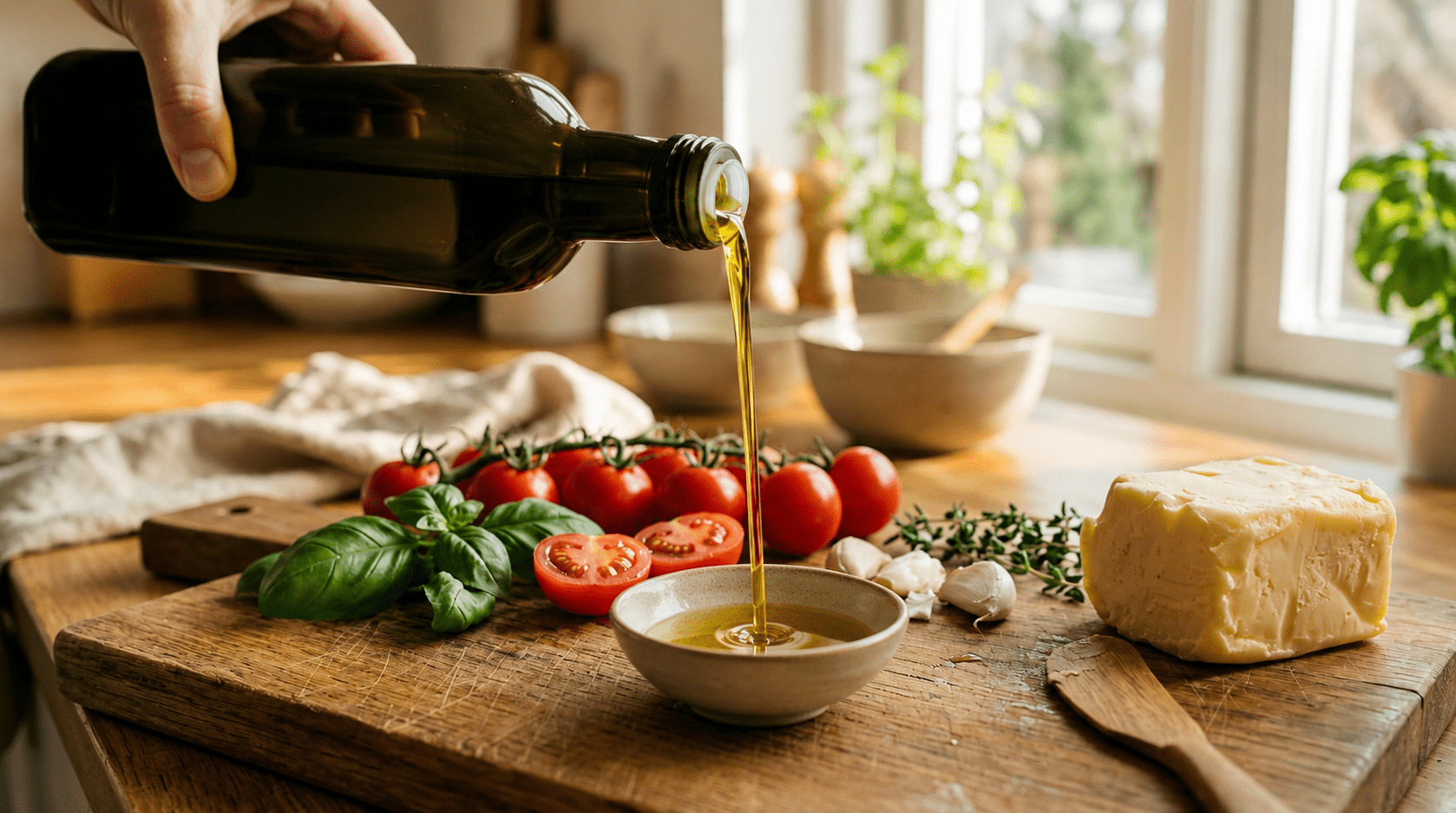
- Sauces and dressings. I make my own: tomatoes, olive oil, garlic, herbs and salt, instead of a jar with soybean oil, sugar and starch.
- Processed food. Reading labels for seed oils became a proxy for cutting ultra-processed food.
- Soy. I avoid it because of the glyphosate question, not the testosterone worries on social media: a meta-analysis of 41 studies found no effect on men’s testosterone or estrogen.
- Home versus restaurants. No seed oils in my kitchen. At restaurants I don’t interrogate the chef; consistency over years matters more than perfection.
- Omega-3. I take 1,200 mg of EPA and DHA a day, to work on the ratio from the other side too.
So, are seed oils bad?
Both sides distort this debate. The critics are right that heated seed oils form toxic compounds, that the omega-6 to omega-3 ratio has shifted, and that seed oils are a marker of ultra-processed food. They overreach when they call the oil itself inflammatory poison.
Mainstream nutrition science is right that linoleic acid in normal amounts doesn’t drive inflammation. But its case for swapping butter for oil is thinner than the consensus suggests: in a 2020 Cochrane review of 15 trials, cutting saturated fat lowered cardiovascular events by 17%, with little or no effect on deaths.
The practical takeaway: cook with stable fats, make your own food where you can, cut ultra-processed food, and get enough omega-3. Six years in, the hardest part isn’t the diet. It’s reading labels and realizing how much of what you thought was food is an industrial product.
Frequently asked questions
How long do seed oils stay in your body?
In fat tissue, years: the one long trial that measured it found a half-time of about 680 days.
Which oil is best for frying?
A fat low in polyunsaturated fat. In frying tests, coconut oil was highly resistant; I use olive oil and butter.
References
- Petersen KS, et al. Nutrition Today 2026;61(1):19–25. Penn State record
- Sadeghi R, et al. J Transl Med 2025;23:314. PMID 40075437
- Wu JHY, et al. Lancet Diabetes Endocrinol 2017;5(12):965–974. PMID 29032079
- Seppanen CM, Csallany AS. J Am Oil Chem Soc 2004;81(12):1137–1141. University of Minnesota record
- Wang L, et al. J Agric Food Chem 2016;64(19):3881–3889. PMID 27128101
- Frying tests at 180 °C. J Food Drug Anal 2023. PMID 37224552
- Grootveld M. Front Nutr 2021;8:711640. PMID 35071288
- Simopoulos AP. Nutrients 2016;8(3):128. PMID 26950145
- University of Bristol, June 2025 (study in Int J Epidemiol). bristol.ac.uk
- Lane MM, et al. BMJ 2024;384:e077310. PMID 38418082
- USDA Economic Research Service, GE adoption trends. ers.usda.gov
- Bøhn T, et al. Food Chem 2014;153:207–215. PMID 24491722
- Reed KE, et al. Reprod Toxicol 2021;100:60–67. PMID 33383165
- Dayton S, et al. J Lipid Res 1966;7(1):103–111. PMID 5900208
- Hodson L, et al. Prog Lipid Res 2008;47(5):348–380. PMID 18435934
- IARC. Glyphosate, March 2015. iarc.who.int
- Hooper L, et al. Cochrane Database Syst Rev 2020;8:CD011737. PMID 32827219
This article is part of the Lab of One series.
Next in this series: The dangers of fake sugars: what the science really says, where you see why not all sweeteners are the same, and what the research says about cancer, heart and brain risks.
⚠️ Disclaimer
This is a personal self-experiment, not medical advice. I’m a 50+ young applying published research to my own body — your physiology, history, and risks are different. Nothing here is a recommendation to start, stop, or change any supplement, medication, or dietary habit. Talk to a qualified doctor before acting on anything you read.
Featured image generated with AI.
Correction, October 19, 2026: An earlier version said a 35% lower diabetes risk came from controlled trials; it came from pooled cohort studies. It also described a “global analysis of 500,000 blood samples” linking the omega ratio to disease; the study measured inflammation markers only. And it said fat tissue fully adjusts in 3 to 4 years; the trial behind that figure measured a half-time of about 680 days.
Discover more from Factnetize
Subscribe to get the latest posts sent to your email.

Pablo Vicento
Liked this? There's more where it came from.
Get our digest — articles worth your time, no spam, unsubscribe in one click.
Subscribe to Factnetize →