⚡ Key takeaways
- Solid: tretinoin softens fine and coarse wrinkles. A 2025 meta-analysis of eight placebo-controlled trials confirmed it.
- Start low and slow. Use a pearl-sized amount on completely dry skin, every other night or less, and build up only as your skin allows.
- Expect a rough first few weeks. Dryness, redness and peeling are common early on and usually mild.
- Patience: results take months. The label says up to six months; I needed about eight.
Tretinoin is a prescription wrinkle cream with placebo-controlled trials behind it, and the first weeks on it can be rough. I came across it in a Mexican pharmacy, where it was advertised on the shelf next to sunscreen, and I have used it ever since. This guide covers how to start tretinoin without wrecking your skin, what is normal in the first weeks, where bakuchiol fits, and what I actually do now.
What is tretinoin, and how is it different from retinol?
Tretinoin is retinoic acid, the form of vitamin A that does the work in your skin. Retinol, the ingredient in over-the-counter creams, has to be converted into retinoic acid, its active metabolite. Tretinoin skips that step.
In the US, tretinoin cream is a prescription drug. The labels on DailyMed are marked “Rx only”, so you need a doctor or dermatologist to prescribe it. If you are new to retinoids, my introduction to retinol is a gentler place to begin.
Does it work? A 2025 systematic review and meta-analysis pooled eight randomized trials with 1,361 patients, followed for 16 weeks to 2 years. Tretinoin improved both fine and coarse facial wrinkles compared with a placebo cream.
What you need
- A prescription. A common starting strength is 0.025%.
- A mild cleanser. The label urges caution with medicated, abrasive or strongly drying soaps.
- A plain moisturizer. Without fragrance or active ingredients.
- Sunscreen every day. Tretinoin makes your skin more sensitive to the sun; the Renova label asks for at least SPF 15.
Step 1: start with a pearl-sized amount, every other night or less
The label for generic tretinoin cream says to apply it once a day before bedtime, and adds that your doctor may have you start every other night if your skin is sensitive. Most skin is sensitive to tretinoin at first, so I started even slower: twice a week.
- Wash your face with a mild cleanser and pat it dry.
- Wait 20 to 30 minutes. The label explains that skin must be completely dry to minimize irritation.
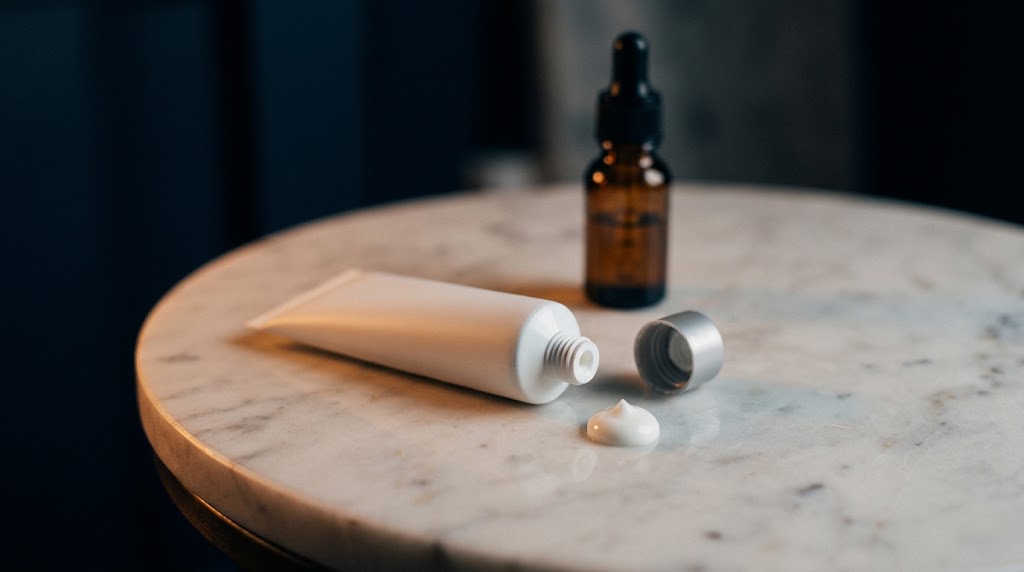
- Apply a pearl-sized amount, about ¼ inch (5 mm), and spread it thinly over the whole face. Keep it away from the eyes, the corners of the nose and the mouth.
- Leave it on. The Renova label advises no washing and no other products for at least one hour.
More cream does not mean faster results. The label is blunt: too much irritates the skin, wastes medication and won’t give better results.
Step 2: build up only as your skin allows
Once you have no lasting redness or burning, add one night a week. The label’s target is once a day at bedtime, but your doctor may settle on fewer nights; I ended up at four.
If your skin gets red, raw or stings, the label’s advice is to use less, apply it less often or pause. You can step back up once your skin has calmed down. That is not failure; it is how the label expects you to use it.
A moisturizer helps with the dryness. The generic label recommends one every morning after you wash, and the Renova label advises waiting an hour after tretinoin before any other product. In my first months I used one at night too; now that my skin tolerates tretinoin well, I skip it in the evening.
Moving up a strength, such as from 0.025% to 0.05%, is your prescriber’s call. When you do, start again at a low frequency. I moved up after finishing my first tube and dropped back to once a week before building up again.
The purge: what is normal in the first weeks
Irritation in the first weeks is common and usually mild. In the 2025 meta-analysis, people on tretinoin had about three times the odds of reporting side effects compared with placebo cream. Dryness, redness, peeling, burning and stinging were the typical ones, mostly early in treatment and mostly mild to moderate.
The “purge” is something else: a flare of pimples. The acne label describes it as an apparent worsening of inflammatory lesions in the early weeks, caused by deeper, previously unseen lesions coming to the surface, and says it is not a reason to stop. MedlinePlus says acne sores should improve in two to three weeks.
Stop and call your doctor if you get swelling, blistering, crusting or burning that is severe or persistent. That is not a purge.
Where bakuchiol fits
Bakuchiol is a plant compound sold as a gentle alternative to retinol. In a 2019 randomized, double-blind trial of 44 people, bakuchiol 0.5% twice a day and retinol 0.5% both reduced wrinkle area and dark spots over 12 weeks, with no significant difference between them. The retinol group had more scaling and stinging.
We found no trial that tested bakuchiol together with tretinoin. A 2026 review by a scientist from a bakuchiol manufacturer argues that it works partly through different pathways than retinoids, so the two could complement each other. That is plausible, not proven: a 2024 systematic review found most bakuchiol trials were uncontrolled or tested mixed products. I use it because my skin tolerates tretinoin better with it, and that is all I can claim.
My routine, and what changed after eight months
I had used a 1% retinol for about two months before I switched to tretinoin 0.025%, twice a week. For several weeks my forehead was flaky and dry, and I had a moderate purge on my forehead and nose. When my skin turned red, I skipped a few nights until it was back to normal.
After one tube I moved to 0.05% and started again at once a week. Around the same time I added a bakuchiol serum, morning and evening, applied 20 to 30 minutes before the tretinoin. That combination made the difference in comfort for me.
Today I use 0.05% on Monday, Tuesday, Thursday and Friday, with Wednesday and the weekend off. Every morning I wash, moisturize and put on sunscreen: SPF 30 on normal days, SPF 50 in summer, plus a cap and sunglasses when I’m outside for long.
It took about eight months before I saw a clear change. The lines beside my eyes and on my forehead are less deep, and my skin feels softer and firmer.
Frequently asked questions
How long does it take for tretinoin to work on wrinkles?
Months, not weeks. The Renova label says some people notice effects at three to four months and that it can take up to six months. The improvement may fade if you stop.
Can I use tretinoin during pregnancy?
No. The Renova label says it should not be used during pregnancy, and the generic label says there are no adequate studies in pregnant women. If you become pregnant while using it, call your doctor.
Do I really need sunscreen every day?
Yes. The label warns of heightened sensitivity to sunlight and says not to use tretinoin on sunburned skin until it has fully healed.
Can I use it with other active ingredients?
Be careful. The label calls out products with sulfur, resorcinol or salicylic acid, products high in alcohol, and astringents. Ask your prescriber before you add an exfoliant.
⚠️ Disclaimer
This is a personal self-experiment, not medical advice. I’m a 50+ young applying published research to my own skin — your skin, history, and risks are different. Tretinoin is a prescription drug in the US: talk to a doctor or dermatologist before you start, change strength, or combine it with other products, and don’t use it if you are pregnant or trying to become pregnant.
Featured image generated with AI.
Correction, October 20, 2026: An earlier version said bakuchiol enhances the effects of tretinoin and that purging lasts two to six weeks or longer. We found no trial that tested bakuchiol with tretinoin, and the label only says a flare can occur in the early weeks.

Pablo Vicento
The Tested Weekly
One email a week with the guides we tested, sources linked. No spam.