⚡ Key takeaways
- 0.8 g/kg is a floor, not a target. If you lift, aim for about 1.6 g/kg per day (up to 2.2).
- Age raises the bar. Older muscles need about 0.4 g/kg per meal (roughly 30–40 g) instead of 20–25 g to get the same response.
- Animal protein is more efficient, plant protein is workable but needs more grams. Soy does not lower testosterone.
- Fibre is the real gut fix for high-protein diets. Apple cider vinegar is not.
Everyone tells you to eat more protein. Few tell you how much, from which source, or what happens to the part your body cannot use. This guide covers protein intake by age, per kilo of body weight, and ranks protein sources from best to worst. It also puts whey under the microscope and shows what actually keeps your gut calm on a high-protein diet. No hype, just what the studies say, including where they disagree.
How much protein per day do you need?
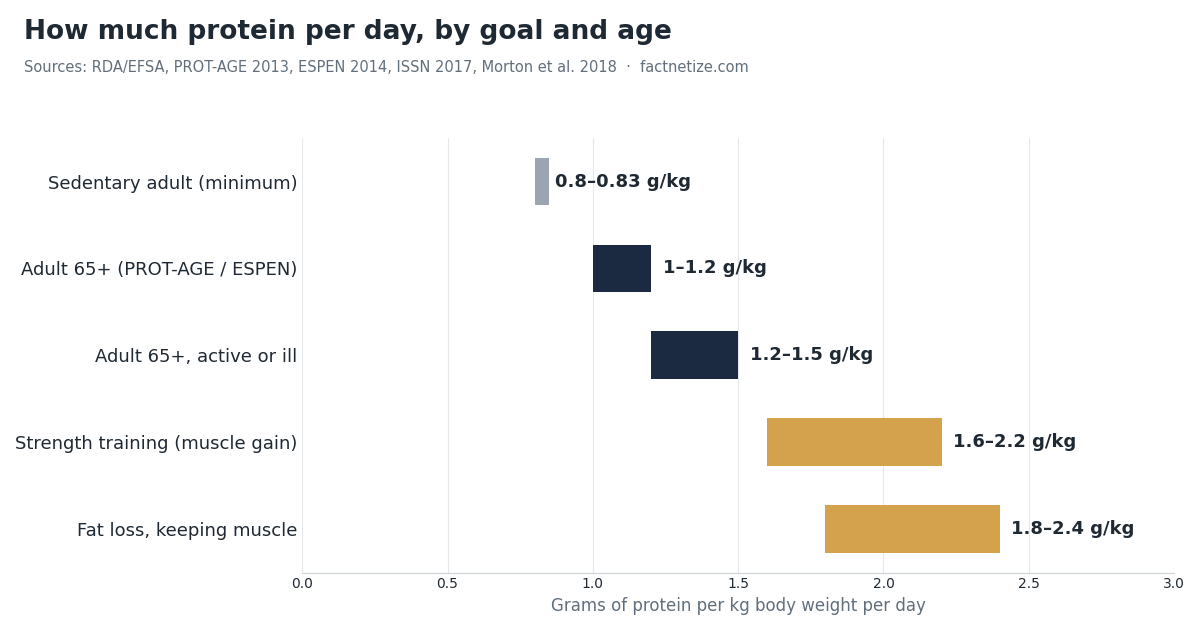
The official number is 0.8 grams per kilo of body weight per day (the US RDA). Europe’s food safety agency EFSA lands on 0.83 g/kg. However, those figures come from nitrogen balance studies. They tell you the minimum to avoid losing protein, not the amount that best protects muscle, strength or function.
For people who train, the best evidence is a 2018 meta-analysis by Morton and colleagues: 49 trials, 1,863 participants. Muscle gains levelled off around 1.62 g/kg per day, with a confidence range up to 2.2 g/kg. The International Society of Sports Nutrition recommends 1.4–2.0 g/kg for most active people.
| Your situation | g/kg per day | 70 kg | 80 kg | 90 kg |
|---|---|---|---|---|
| Sedentary (minimum) | 0.8 | 56 g | 64 g | 72 g |
| Age 65+ | 1.0–1.2 | 70–84 g | 80–96 g | 90–108 g |
| Strength training | 1.6–2.2 | 112–154 g | 128–176 g | 144–198 g |
| Losing fat, keeping muscle | 1.8–2.4 | 126–168 g | 144–192 g | 162–216 g |
Dieting changes the maths. In a 2016 McMaster trial, 40 young men ate 40% below their energy needs for four weeks while training hard. The group on 2.4 g/kg gained lean mass and lost more fat than the group on 1.2 g/kg. That is a short, small study, so treat 2.4 as the upper end for aggressive diets, not a new default.
Carrying extra body fat? Base the calculation on your target weight, not your current weight, or you will overshoot.
Protein intake by age: why older muscles need more
From around 40–50, you slowly lose muscle mass and strength. This is called sarcopenia, and it speeds up after 65. The key mechanism behind it is anabolic resistance: older muscles respond less to the same dose of protein.
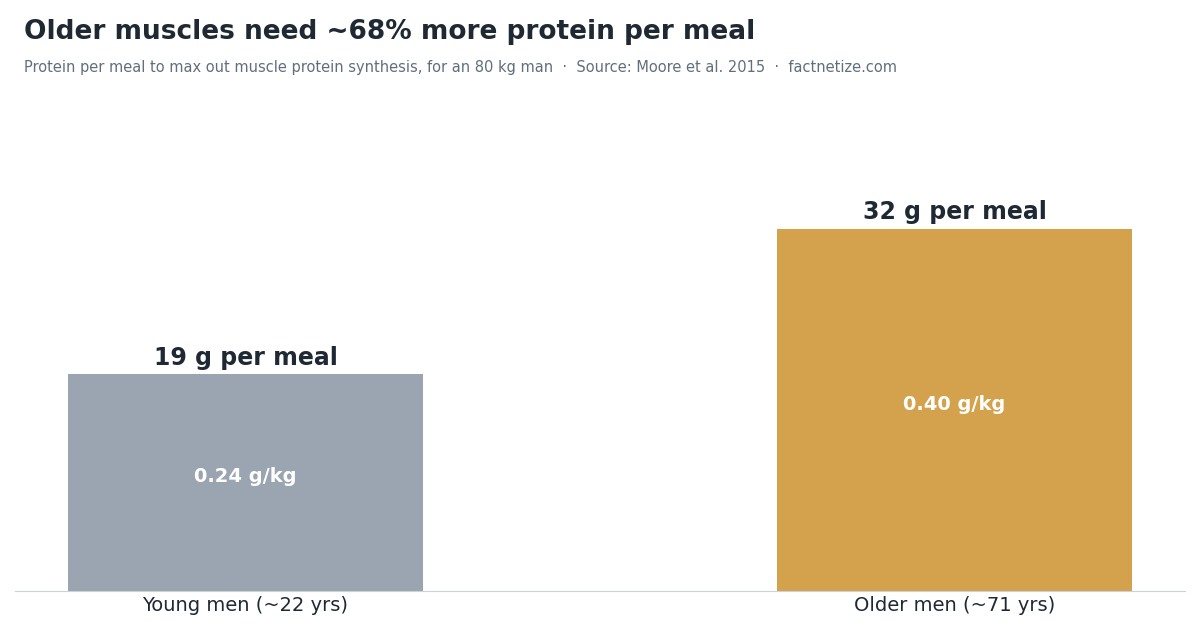
A pooled analysis by Moore and colleagues (2015) measured this directly. Young men maxed out muscle protein synthesis at 0.24 g/kg per meal. Older men needed 0.40 g/kg. For an 80 kg man, that is the difference between about 19 g and 32 g of protein per meal.
| Age group | Daily target | Per meal | Evidence |
|---|---|---|---|
| 18–40 | 0.8 minimum, 1.6 if training | ~0.25–0.4 g/kg | Strong |
| 40–65 | 1.0–1.2, 1.6+ if training | ~0.3–0.4 g/kg | Extrapolated (no official norm) |
| 65+, healthy | at least 1.0–1.2 | ~0.4 g/kg (30–40 g) | Moderate (PROT-AGE, ESPEN) |
| 65+, active or ill | 1.2–1.5 | ~0.4 g/kg | Moderate |
| Kidney disease | Ask your doctor | – | Clinical guidance |
Here is the part most “eat more protein” articles skip. The Dutch Health Council reviewed trials in older adults who already ate at least 0.8 g/kg. Extra protein helped lean mass a little, and helped strength only when combined with training. On its own, it did little for physical function. Keep in mind that the higher targets from PROT-AGE and ESPEN are expert consensus, built mostly on short-term muscle measurements and observational data, not on trials with hard outcomes such as falls, fractures or mortality.
In other words, training is the strongest protein amplifier you have. A McMaster study showed that just two weeks of low activity (about 1,500 steps a day) caused leg muscle loss and anabolic resistance in healthy older adults. Protein supports muscle; lifting is what tells your body to keep it.
Protein sources ranked from best to worst
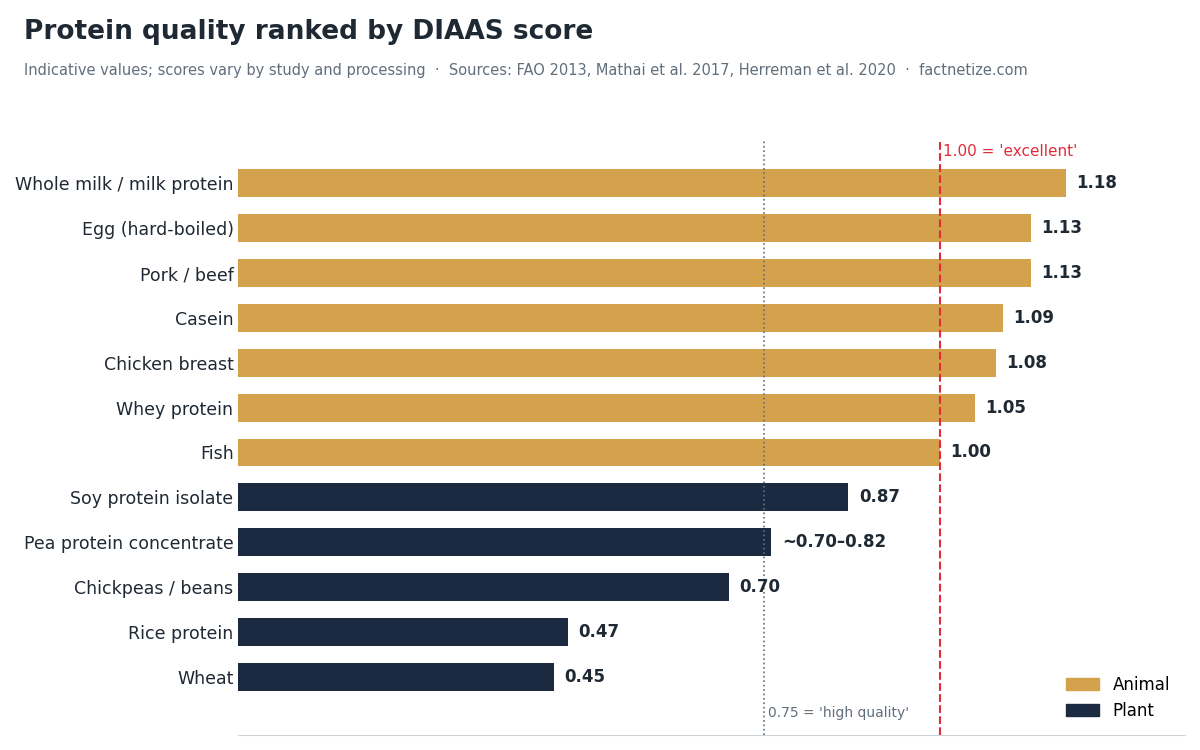
Not all protein is equal. Scientists score protein quality with DIAAS (Digestible Indispensable Amino Acid Score). The values below come from Mathai et al. 2017 and Herreman et al. 2020. A score of 1.00 or higher is “excellent”, 0.75–0.99 is “high quality”. A second factor matters for muscle: leucine, the amino acid that switches on muscle building.
| Rank | Source | DIAAS | Leucine (% of protein) | Verdict |
|---|---|---|---|---|
| 1 | Milk / whey / casein | 1.05–1.18 | 8–11% | 🟢 Top tier. Whey has the most leucine. |
| 2 | Eggs | 1.13 | ~7% | 🟢 Complete and cheap |
| 3 | Beef, pork, chicken | 1.08–1.14 | ~8% | 🟢 Dense protein per portion |
| 4 | Fish | ~1.00 | ~8% | 🟢 Complete, plus omega-3 |
| 5 | Soy isolate | 0.84–0.90 | ~8% | 🟡 Best plant option |
| 6 | Pea protein | ~0.70–0.82 | ~8% | 🟡 Low in methionine, blend it |
| 7 | Beans, lentils, chickpeas | 0.60–0.83 | varies | 🟠 Good food, weaker protein |
| 8 | Rice, wheat, oats, hemp | 0.37–0.48 | 5–8% | 🔴 Low in lysine |
Why does animal protein win? It contains more essential amino acids (whey 43%, milk 39%, versus 21–22% for oat, lupin and wheat isolates in a 2018 Maastricht analysis). It is also easier to digest.
A 25 g serving of whey delivers about 2.7 g of leucine. To get the same from plant protein, you need about 32–34 g of soy or pea protein, and more than 50 g of hemp protein.
One honest caveat: when total intake is high enough, the source matters less. A 2022 Maastricht study found that 30 g of a wheat-corn-pea blend stimulated muscle building about as well as 30 g of milk protein. Quality counts most when intake is low, meals are small, or you are older. Note the difference: DIAAS scores quality per gram, while these studies measure the muscle response to a full serving. A lower score means you need more, not that it cannot work.
Soy, pea and vegan claims: myth vs fact
This is where both camps overstate their case. Let’s go through the claims one by one.
| The claim | Verdict | What the evidence says |
|---|---|---|
| “Soy is GMO junk” | ⚠️ Partly true | Most US and Brazilian soy is GM (see my seed oils article). The EU labels GM above 0.9% and organic bans it. US National Academies (2016) found no persuasive evidence of health harm from eating approved GM crops. Prefer organic? That is a fair personal choice, not a health finding. |
| “Soy estrogen feminises men” | ❌ Not supported | Soy contains isoflavones that resemble estrogen, but a 2021 meta-analysis of 41 clinical studies found no effect on testosterone, free testosterone or estradiol in men, confirming an earlier 2010 analysis. Transparency note: co-author Mark Messina works for a soy-industry-funded institute. The rare reported case of breast growth in a man involved about three litres of soy milk a day (Martinez & Lewi 2008). |
| “Pea protein is incomplete” | ⚠️ Half true | Pea protein contains all nine essential amino acids, but methionine is low. That drags its score down to roughly 0.70–0.82. Still, a 2024 Maastricht study found 30 g of pea protein built muscle protein as well as 30 g of milk protein in young men. Mixing pea with rice fills the methionine gap, which is why most vegan powders are blends. |
| “Plant protein is just as good” | ❌ False, gram for gram | Plant protein has less leucine and lower digestibility. Vegans need roughly 10–20% more protein, or smart blends, to match the effect. |
| “You can’t build muscle on plants” | ❌ Also false | With enough total protein, results are similar. A 2018 meta-analysis of nine trials (again co-authored by Messina) found no difference in strength or lean mass gains between soy and animal protein during resistance training. |
The bottom line: Animal protein is more efficient. Plant protein works, but takes more effort. My own choice is whey and animal protein, simply because I get more muscle-building value per gram and per calorie.
Whey protein: which type and how much
Whey is not magic, it is convenience. (It also tops my supplement stack tier list, and I pair it with collagen as described in my collagen protocol.) It is one of the easiest ways to hit a protein target, and it has the highest leucine content of the common proteins.
| Type | Protein | Lactose | Price tier | Best for |
|---|---|---|---|---|
| Concentrate | 70–80% | Some | Budget | Most people. Same muscle results, lowest cost. |
| Isolate | 90%+ | Very little | Mid | Lactose-sensitive guts, strict calorie counting |
| Hydrolysate | 90%+, pre-digested | Very little | Frontier | Medical use. No proven extra benefit for healthy people. |
How much per shake? Aim for 25–40 g of whey, which delivers the 2.5–3 g of leucine that reliably triggers muscle building. Older adults should sit at the high end.
You may have heard that your body can only use 20–25 g of protein per meal. A 2023 Maastricht study (Trommelen et al.) tested 100 g versus 25 g after a workout. The larger dose produced a bigger and longer anabolic response, lasting more than 12 hours.
So no, extra protein is not simply wasted. That said, the study was small, used untrained young men, and measured 12 hours rather than months of growth. Spreading protein over three to five meals is still the smartest default.
Timing around your workout matters far less than hitting your daily total.
What happens to protein you don’t digest
Some people feel bloated after a whey shake. Usually the whey is not the problem. The usual suspects are lactose (more in concentrate), sugar alcohols such as sorbitol and maltitol, gums, or simply drinking too much too fast.
There is a second mechanism. Protein that escapes digestion in the small intestine reaches the colon. There, bacteria ferment it, a process called putrefaction. That produces compounds you do not want in large amounts (review).
| Byproduct | Why it matters |
|---|---|
| Ammonia | Can damage the gut lining at high concentrations |
| Hydrogen sulfide (H₂S) | From sulfur amino acids; blocks colon cells from using butyrate for fuel |
| p-Cresol and phenols | Linked to DNA damage in lab studies |
| Indoles | Mixed evidence: some harmful, some possibly beneficial |
Keep perspective. At normal intakes, these compounds are unlikely to reach toxic levels. The real risk pattern is specific: high protein combined with low carbohydrate and low fibre. A 2011 Rowett Institute trial showed that exactly this combination raised harmful fermentation products and cut protective butyrate.
What actually helps your gut (and what doesn’t)
Plenty of products promise to “detox” protein waste. Here is how the options stack up on evidence.
| Strategy | Evidence | What the research shows |
|---|---|---|
| Resistant starch and fibre | 🟢 Strong | In a human trial, resistant starch cut faecal ammonia by about 30% and phenols by about 43%. Bacteria switch from protein to fibre. |
| Psyllium husk | 🟢 Good | A 2022 trial in Gut showed it sharply reduced colonic gas from fermentable fibre. Always take it with plenty of water. |
| Whey isolate instead of concentrate | 🟢 Good | Removes most lactose, the most common cause of whey bloating. |
| Smaller, spread-out servings | 🟡 Logical | Less protein overflows into the colon. |
| Protease enzymes | 🟡 Limited | Small trials show faster amino acid uptake from whey. Mostly funded by manufacturers. |
| Prebiotics (inulin) | 🟡 Limited | Lowered p-cresol in small studies. Can cause gas itself. |
| Broccoli, green veg, chlorophyll | 🟠 Weak | Mainly rat studies on red-meat heme, not protein waste in general. Great food anyway. |
| Probiotic supplements | 🟠 Weak | Probiotics alone did not lower protein toxins in kidney-patient trials. |
| Apple cider vinegar | 🔴 Not supported | No good evidence it improves protein digestion. A small 2007 study found it slowed stomach emptying. |
And water? Your kidneys clear protein waste as urea, so drink enough, especially above 2 g/kg. A 2006 study in trained athletes found the effect of very high protein on hydration was minimal, though. Pale yellow urine is a better guide than any fixed number of litres.
A sample high-protein day
Here is what 1.6–2.0 g/kg looks like for an 80 kg man (target 130–160 g), with the gut-friendly habits built in.
☀️ Breakfast · ~40 g protein
Greek yoghurt or quark with oats and berries, or three eggs on wholegrain toast.
🥗 Lunch · ~35 g protein
Chicken or fish with cooled potatoes or rice (resistant starch) and vegetables.
🏋️ Around training · ~30 g protein
30 g whey isolate in water or milk, sipped slowly, with a banana.
🍽️ Dinner · ~40 g protein
Beef, pork or salmon with lentils or beans, and broccoli or cabbage.
🌙 Optional before bed · ~20–30 g protein
Cottage cheese or quark (slow casein).
Take psyllium separately, with a full glass of water.
Before you go all-in
- Kidneys: a 2018 meta-analysis found no difference in kidney function between high and normal protein diets in healthy adults. With existing kidney disease, talk to your doctor first.
- Body weight: most g/kg advice assumes a normal weight. With obesity, use your target weight.
- Lab results aren’t muscle: many studies on dose and timing measure muscle building for 3–12 hours in small groups. Long-term growth is what counts.
- Industry funding: dairy companies fund part of this field. It is usually disclosed, and worth keeping in mind.
Frequently asked questions
How much protein do I need per day by age?
Adults under 65 need at least 0.8 g per kg of body weight, and about 1.6 g/kg if they strength train. From 65, aim for at least 1.0–1.2 g/kg, and 1.2–1.5 g/kg if you are active or recovering from illness.
Is whey isolate better than whey concentrate?
For muscle growth, no. Both work equally well. Isolate is only worth the extra cost if lactose upsets your stomach or you want fewer calories per serving.
Does soy protein lower testosterone in men?
No. Meta-analyses of clinical studies found no effect of soy or soy isoflavones on testosterone or estrogen levels in men at normal intakes.
Why does protein powder make me bloated?
The most common causes are lactose in whey concentrate, sugar alcohols, gums, and drinking a large shake too quickly. Try an isolate without “-ol” sweeteners, halve the dose for a few days, and eat enough fibre.
Can you eat too much protein?
For healthy adults, intakes up to about 2.2 g/kg are well studied and considered safe. Above that, there is no proven extra benefit for muscle, and you crowd out fibre and carbohydrates your gut needs.
Conclusion
Protein intake by age comes down to three numbers: 0.8 g/kg to survive, 1.6 g/kg to build, and 0.4 g/kg per meal once you are older. Choose mainly animal protein or smart plant blends, use whey as a convenient top-up, and pair all of it with fibre. Then do the one thing no supplement replaces: lift something heavy. Want to go deeper into the science of feeling better? Browse the rest of the Lab of One series.
Sources
All peer-reviewed unless noted. Industry funding or ties are flagged where relevant.
- EFSA Panel (2012). Scientific opinion on dietary reference values for protein. EFSA Journal. doi:10.2903/j.efsa.2012.2557
- Morton RW et al. (2018). Protein supplementation and resistance training gains: meta-analysis. Br J Sports Med. PubMed 28698222
- Jäger R et al. (2017). ISSN position stand: protein and exercise. J Int Soc Sports Nutr. PMC5477153
- Longland TM et al. (2016). Higher vs lower protein during an energy deficit. Am J Clin Nutr. PubMed 26817506 (senior author has received dairy-industry funding)
- Moore DR et al. (2015). Protein per meal in older vs younger men. J Gerontol A. PubMed 25056502
- Bauer J et al. (2013). PROT-AGE Study Group recommendations. J Am Med Dir Assoc. PubMed 23867520
- Deutz NEP et al. (2014). ESPEN Expert Group: protein intake and exercise with aging. Clin Nutr. ScienceDirect
- Health Council of the Netherlands (2022). Protein above the PRI in older adults: systematic review. Adv Nutr. PMC9340973
- Breen L et al. (2013). Two weeks of reduced activity and anabolic resistance in older adults. J Clin Endocrinol Metab. PubMed 23589526
- Mathai JK, Liu Y, Stein HH (2017). DIAAS for dairy and plant proteins. Br J Nutr. doi:10.1017/S0007114517000125 (funded by the National Dairy Council)
- Herreman L et al. (2020). Protein quality of plant and animal sources based on DIAAS. Food Sci Nutr. doi:10.1002/fsn3.1809
- Gorissen SHM et al. (2018). Amino acid composition of plant-based protein isolates. Amino Acids. doi:10.1007/s00726-018-2640-5
- Pinckaers PJM et al. (2022). Plant protein blend vs milk protein. J Nutr. PMC9839989
- Pinckaers PJM et al. (2024). Pea protein vs milk protein. Eur J Nutr. doi:10.1007/s00394-023-03295-6
- National Academies of Sciences (2016). Genetically Engineered Crops: Experiences and Prospects (report, not peer-reviewed journal). doi:10.17226/23395
- EU Regulation (EC) No 1829/2003 on GM food and feed (legislation). EUR-Lex summary
- Reed KE et al. (2021). Soy and male reproductive hormones: updated meta-analysis. Reprod Toxicol. PubMed 33383165 (co-author with soy-industry ties)
- Hamilton-Reeves JM et al. (2010). Soy and reproductive hormones in men: meta-analysis. Fertil Steril. doi:10.1016/j.fertnstert.2009.04.038 (co-author with soy-industry ties)
- Martinez J, Lewi JE (2008). Gynecomastia associated with soy consumption (case report). Endocr Pract. doi:10.4158/EP.14.4.415
- Messina M et al. (2018). Soy vs animal protein for muscle and strength: meta-analysis. Int J Sport Nutr Exerc Metab. doi:10.1123/ijsnem.2018-0071 (lead author with soy-industry ties)
- Trommelen J et al. (2023). Anabolic response to 100 g vs 25 g protein. Cell Rep Med. PMC10772463
- Yao CK, Muir JG, Gibson PR (2016). Colonic protein fermentation: review. Aliment Pharmacol Ther. PubMed 26527169
- Russell WR et al. (2011). High-protein, reduced-carbohydrate diets and colonic metabolites. Am J Clin Nutr. PubMed 21389180
- Birkett A et al. (1996). Resistant starch lowers faecal ammonia and phenols in humans. Am J Clin Nutr. AJCN
- Gunn D et al. (2022). Psyllium reduces inulin-induced colonic gas. Gut. PubMed 34353864
- Oben J et al. (2008). Protease blend and whey protein absorption. J Int Soc Sports Nutr. doi:10.1186/1550-2783-5-10 (manufacturer-involved)
- De Preter V et al. (2007). Probiotics, prebiotics and colonic protein metabolism. Am J Physiol GI. doi:10.1152/ajpgi.00052.2006
- De Vogel J et al. (2005). Chlorophyll and heme in rat colon. Carcinogenesis. Oxford Academic
- Meta-analysis (2022). Microbiota-driven therapy and uremic toxins in kidney disease. Adv Nutr. ScienceDirect
- Hlebowicz J et al. (2007). Apple cider vinegar and gastric emptying (pilot). BMC Gastroenterol. PMC2245945
- Martin WF et al. (2006). Dietary protein and hydration in athletes. J Am Diet Assoc. ScienceDirect
- Devries MC et al. (2018). High-protein diets and kidney function: meta-analysis. J Nutr. doi:10.1093/jn/nxy197

Pablo Vicento
Liked this? There's more where it came from.
Get our digest — articles worth your time, no spam, unsubscribe in one click.
Subscribe to Factnetize →